UPSC Prelims negative marking: when should you guess?
In UPSC Prelims a wrong answer costs one third of the question's marks, so guessing pays only when you can eliminate options; here is how to decide, question by question.
 By The Abhayastra team5 min readUpdated 15 October 2026
In this article
- 1. How does negative marking work in UPSC Prelims?
- 2. When does guessing make mathematical sense?
- 3. What is a good attempt strategy for Prelims?
- 4. Which elimination techniques work best?
- 5. How do you find your own safe attempt range?
- 6. What mistakes increase negative marking?
- 7. Summary: when to guess in UPSC Prelims
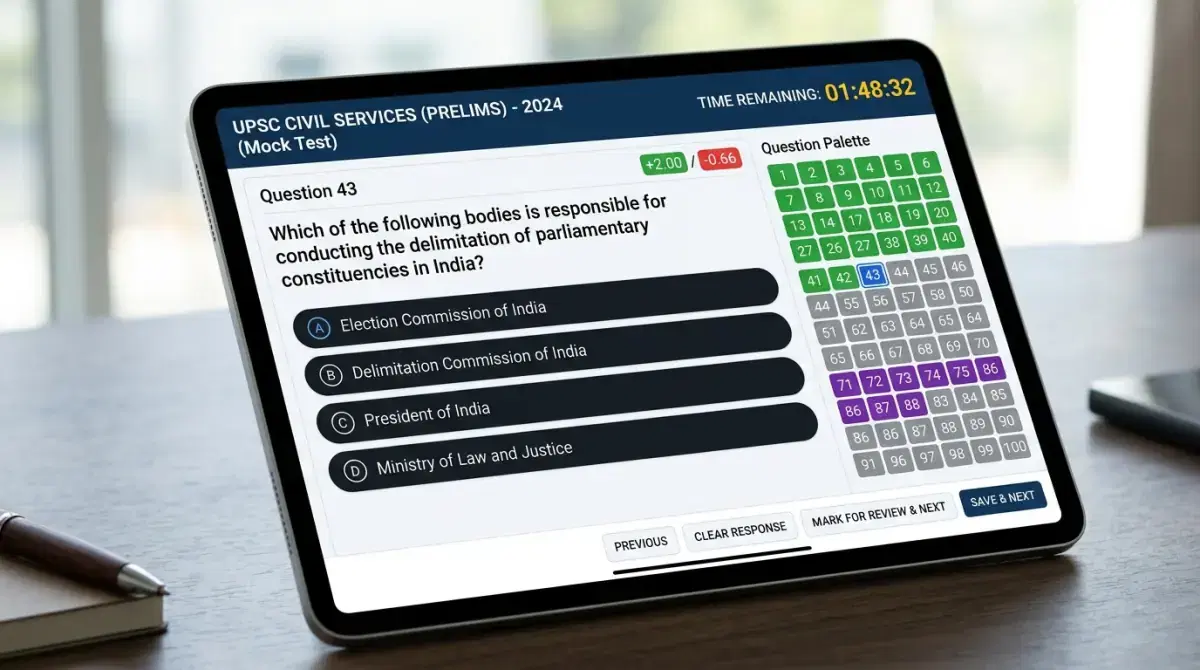
In UPSC Prelims General Studies Paper I, a wrong answer costs one third of the marks allotted to that question, so for a 2-mark question you lose about 0.66 marks. A guess is worth taking when you can confidently eliminate at least two of the four options, and usually not worth taking when you cannot eliminate any.
This article explains the arithmetic behind that rule, how to build an attempt strategy from your own practice data, and the elimination techniques that turn blind guesses into educated ones.
How does negative marking work in UPSC Prelims?
Each question in the objective papers has four options. A correct answer earns the full marks for the question. A wrong answer deducts one third of those marks. An unanswered question earns and loses nothing.
| Outcome | GS Paper I (2-mark question) | Effect |
|---|---|---|
| Correct | +2 | Full marks |
| Wrong | -0.66 | One third deducted |
| Left blank | 0 | No change |
The CSAT paper (Paper II) is qualifying, and it also carries negative marking for wrong answers. Because CSAT only needs to be cleared, many aspirants are more cautious there and attempt only what they are reasonably sure of. Always check the latest official notification for the current scheme of marks.
When does guessing make mathematical sense?
Think of a guess as a small bet. If you pick randomly among all four options, your chance of being right is one in four. Over many such guesses, the expected gain is close to zero: roughly as many marks are lost to wrong answers as are earned from right ones.
The picture changes the moment you eliminate options. The table below shows the expected marks from a guess on a 2-mark question, depending on how many options remain.
| Options left after elimination | Chance of a correct guess | Expected marks per guess |
|---|---|---|
| 4 (no elimination) | 25% | About 0 |
| 3 (one option eliminated) | 33% | About +0.22 |
| 2 (two options eliminated) | 50% | About +0.67 |
| 1 (three eliminated) | Certain | +2 |
What is a good attempt strategy for Prelims?
There is no fixed 'right' number of attempts. The right number is the one at which your accuracy stays high enough that wrong answers do not cancel your gains. That number is personal and you can only find it through practice.
- 1
Round one: answer what you know
Go through the whole paper once and mark only the questions you are confident about. This secures your base marks quickly.
- 2
Round two: educated guesses
Return to the questions where you can eliminate two options. Use the reasoning techniques below and attempt these.
- 3
Round three: decide on the rest
For questions where you cannot eliminate anything, leave them unless your practice data shows your accuracy on such questions is good.
- 4
Keep time for marking
Leave the last few minutes to fill the answer sheet carefully. A bubbling mistake is the most avoidable loss of all.
Abhayastra's full-paper tests apply the official marking, including the deduction for wrong answers, so the score you see in practice is the score you would actually get. Track it across papers to find your safe attempt range.
Which elimination techniques work best?
Elimination is the skill that turns a 25 percent guess into a 50 percent one. These techniques work well on UPSC-style statement questions.
Watch for extreme words
Statements with words such as 'only', 'always', 'never' or 'all' are wrong more often than not, because policy and constitutional matters usually have exceptions. Treat them with suspicion, but not as an automatic rule.
Use the structure of 'how many' questions
Questions that ask how many statements are correct punish partial knowledge, because you need every statement right. Be more cautious with these than with traditional single-option questions.
Compare options against each other
In match-the-pair and combination questions, one pairing you are certain of can eliminate two or three options at once. Start from your most confident pair.
Apply first principles
Many questions can be reasoned out from basic understanding of how the Constitution, economy or environment works, even without the exact fact. Ask what would make sense, then check for traps in the wording.
How do you find your own safe attempt range?
Your past practice papers already contain the answer. For each full paper, record three numbers: questions attempted, questions correct and net score. Then look at how accuracy changes as attempts go up.
- If accuracy stays high as you attempt more, your guesses are educated and you can attempt a little more.
- If accuracy drops sharply after a certain point, that point is roughly where your guesses stop helping.
- Track accuracy separately for questions you marked as 'sure' and as 'guess'. The guess accuracy is the number that decides your strategy.
Wrong answers from these papers are worth more than the right ones, because each points to a gap or a reading error. Abhayastra's Mistake Book keeps every wrong answer and brings it back until you get it right, and the Strength Map shows which topics produce the most mistakes.
What mistakes increase negative marking?
- Attempting every question out of fear of leaving marks behind.
- Changing a confident answer at the last minute without new reasoning.
- Misreading qualifiers such as 'not', 'incorrect' or 'only'.
- Guessing on 'how many of the above' questions with partial knowledge of the statements.
- Spending too long on one hard question and rushing the easier ones later.
- Never practising with negative marking switched on before the real examination.
Summary: when to guess in UPSC Prelims
| Situation | Suggested action |
|---|---|
| You know the answer | Attempt |
| You can eliminate two options | Usually attempt |
| You can eliminate one option | Attempt only if your practice data shows good accuracy here |
| You cannot eliminate any option | Usually leave it |
| 'How many statements are correct' with partial knowledge | Be cautious; often leave it |
Negative marking rewards calm, practised judgement. Build your rules from your own data, test them in full papers, and the examination hall will feel like one more practice session.
Frequently asked questions
How much is deducted for a wrong answer in UPSC Prelims?
One third of the marks allotted to that question is deducted. For a 2-mark question in General Studies Paper I, that is about 0.66 marks. Check the latest official notification for the current scheme.
Is there negative marking for unanswered questions?
No. A question you leave blank earns and loses nothing. Only wrong answers are penalised.
Does CSAT have negative marking?
Yes, CSAT (Paper II) also deducts marks for wrong answers. Because CSAT is only qualifying, many aspirants attempt it carefully and avoid risky guesses.
How many questions should I attempt in UPSC Prelims?
There is no single right number. The best number is the one at which your accuracy stays high, and you can find it by tracking attempts and accuracy across full practice papers with negative marking.
Should I guess if I can eliminate two options?
Usually yes. With two options left, a guess is right about half the time, which on average gains marks even after the deduction for wrong answers.
Is random guessing ever a good idea?
Rarely. A completely random guess among four options gains almost nothing on average and adds risk, so it is generally better to leave such questions.
How can I practise with real negative marking?
Take full past papers under a timer with the official marking applied. Abhayastra's free full-paper tests deduct marks for wrong answers exactly like the examination, so your practice scores are realistic.