How to use UPSC previous year questions (PYQs) the right way
Previous year questions show what UPSC actually asks and how it asks it; this guide explains how many years to solve, in what order, and how to turn every mistake into marks.
 By The Abhayastra team7 min readUpdated 15 October 2026
In this article
- 1. Why are previous year questions so important for UPSC?
- 2. How many years of UPSC PYQs should you solve?
- 3. Should you solve PYQs topic-wise or year-wise?
- 4. How do you analyse a PYQ after solving it?
- 5. How should you use PYQs for UPSC Mains?
- 6. How do PYQs help with negative marking in Prelims?
- 7. What mistakes do aspirants make with PYQs?
- 8. What does a weekly PYQ plan look like?
- 9. Summary: the right way to use UPSC PYQs
Previous year questions (PYQs) are the single most reliable guide to the UPSC Civil Services Examination, because they show exactly which topics the examiner returns to and how a question is framed. The right way to use them is not to read them once at the end, but to solve them early, topic by topic, and to analyse every mistake until the pattern behind it is gone.
This guide covers why PYQs matter more than any mock series, how many years to solve, whether to go topic-wise or year-wise, and how to use them for both Prelims and Mains. It ends with a weekly plan you can start this week.
Why are previous year questions so important for UPSC?
The UPSC syllabus is short on paper and almost unlimited in practice. A line such as 'Indian Polity and Governance' can cover thousands of pages. PYQs narrow that space by showing which parts of a topic are actually examined, and at what depth.
PYQs also teach the language of the paper. UPSC uses statement-based questions, 'how many of the above' formats, match-the-pair questions and assertion-reason style items. An aspirant who has solved hundreds of these recognises the trap in a statement much faster than one who has only read the theory.
- They reveal recurring themes, such as constitutional bodies, environment conventions or ancient Indian culture.
- They show the depth expected: whether a topic is asked at the level of a definition or of a detailed provision.
- They expose elimination techniques, because many options can be ruled out with basic reasoning.
- They are free of the errors and guesswork that sometimes appear in commercial mock tests.
How many years of UPSC PYQs should you solve?
For Prelims General Studies, aim to solve the papers from roughly the last 10 to 15 years. The examination's style changed noticeably over the last decade, so recent papers are the best guide to the current pattern, while older papers remain useful for static subjects such as polity, history and geography.
| Paper | Suggested range | Why |
|---|---|---|
| Prelims GS Paper I | Last 10 to 15 years | Covers the current pattern and the long-running static themes. |
| Prelims CSAT (Paper II) | Last 5 to 8 years | Enough to learn the question types and your own speed. |
| Mains GS Papers I to IV | Since the current Mains pattern began | Shows the directive words and topics the examiner prefers. |
| Essay | As many past essays as you can read | Helps you recognise the recurring philosophical and social themes. |
Quality beats quantity. Ten years solved and analysed carefully is worth more than twenty years skimmed. Always confirm the current pattern and syllabus in the latest official UPSC notification before planning.
Should you solve PYQs topic-wise or year-wise?
Use both, at different stages. Topic-wise practice builds understanding while you are covering the syllabus. Year-wise practice, as a full timed paper, builds exam temperament closer to the examination.
- 1
While studying a subject: topic-wise
After finishing a chapter, solve every PYQ on that topic. You see immediately what UPSC asks from what you just read, and you mark the gaps in your notes.
- 2
After the first round of the syllabus: sectional tests
Mix PYQs from one subject across years, for example all polity questions, under a timer. This reveals which subjects are genuinely strong.
- 3
In the last months: full papers, year-wise
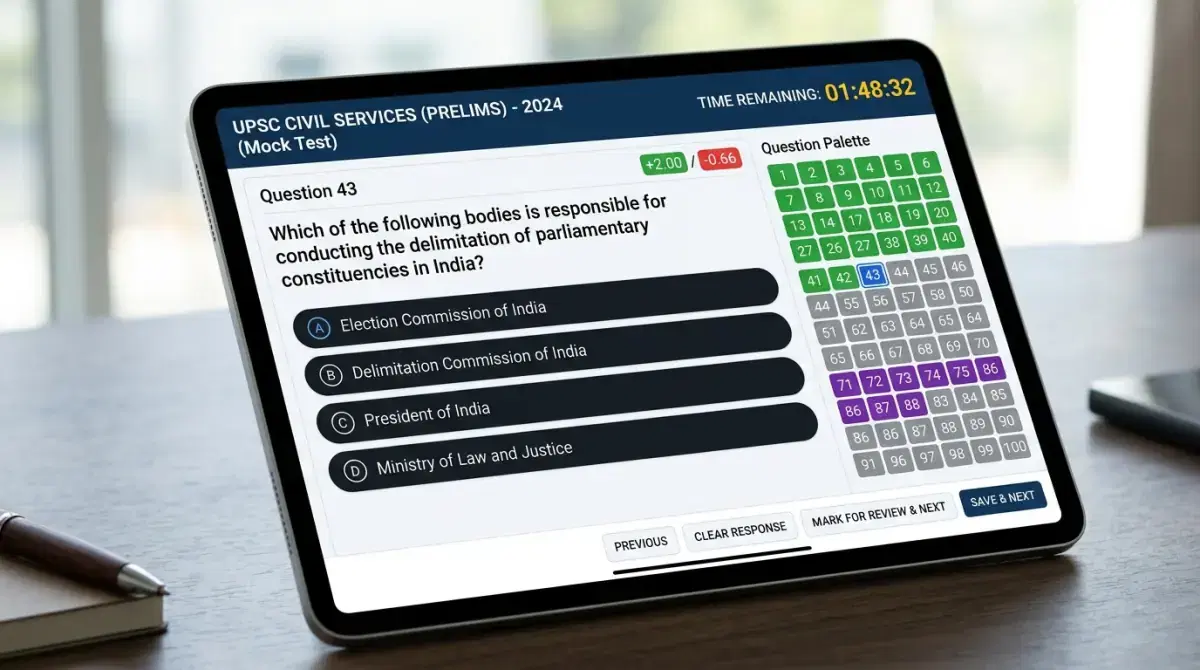
Sit a complete past paper in two hours with negative marking. This trains time management, attempt strategy and nerves.
On Abhayastra, the PYQ Bank lets you filter questions by paper, year and topic, so you can do the topic-wise stage straight after a chapter, and the test engine runs full papers with the official time limit and negative marking for the final stage.
How do you analyse a PYQ after solving it?
Analysis is where most of the improvement happens. For every question you got wrong or guessed, write down why. The reason almost always falls into one of a few categories.
| Type of mistake | What it looks like | What to do |
|---|---|---|
| Knowledge gap | You had never read the fact or concept. | Add the concept to your notes and read the related topic around it. |
| Misreading | You missed a word such as 'not', 'only' or 'all'. | Slow down on statement questions and underline qualifiers. |
| Over-thinking | You knew the answer but talked yourself out of it. | Trust first-principles reasoning; note these questions separately. |
| Wild guess | You attempted with no basis at all. | Review your guessing rules (see the section on negative marking). |
| Confusion between similar facts | You mixed up two bodies, articles or conventions. | Make a comparison table for the pair. |
Once you start tagging mistakes this way, patterns appear quickly. Many aspirants discover that a large share of their lost marks comes from misreading rather than from missing knowledge, which is far easier to fix.
How should you use PYQs for UPSC Mains?
Mains PYQs are less about facts and more about the directive and the expected structure. Reading them shows that UPSC repeatedly asks about certain themes, such as federalism, the role of civil services, climate adaptation or ethics in public life, from different angles.
- Group past Mains questions by syllabus topic, so each topic has a list of how it has been asked.
- Note the directive word: discuss, examine, critically analyse, comment. Each expects a different balance of description and judgement.
- Write at least a few answers per topic under time, then compare your structure with a good model answer.
- Build short notes of examples, reports and case studies that fit the recurring themes.
Writing matters more than reading for Mains. Abhayastra's Mains Answer Check lets you photograph a handwritten answer and get structured feedback, which is useful when you practise past questions on your own.
How do PYQs help with negative marking in Prelims?
In Prelims General Studies, a wrong answer costs one third of the marks for that question, so a careless attempt is expensive. Solving many PYQs under a timer teaches you which kinds of questions you usually get right with partial knowledge, and which you should leave.
Track your accuracy on attempted questions in each full paper. If you know your accuracy on 'educated guesses' from past papers, you can decide calmly in the examination hall instead of guessing from anxiety.
What mistakes do aspirants make with PYQs?
- Leaving PYQs until the last month, when there is no time left to fix what they reveal.
- Reading questions with the answer visible instead of attempting them first.
- Counting the number of questions solved rather than the number of mistakes analysed.
- Ignoring older papers completely, even for static subjects where they are still valuable.
- Memorising answers to specific questions instead of the concept behind them.
- Never sitting a full paper under exam conditions before the actual examination.
What does a weekly PYQ plan look like?
The plan below fits alongside regular syllabus study. Adjust the days to your own timetable; the point is that PYQs become a routine, not a final-month activity.
| Day | PYQ activity | Time |
|---|---|---|
| Monday to Thursday | Topic-wise PYQs for the chapter you studied that day | 30 to 45 minutes |
| Friday | Review the Mistake Book: reattempt last week's wrong answers | 45 minutes |
| Saturday | One sectional test on a full subject under a timer | 60 minutes |
| Sunday | One full past paper in two hours, then analysis | 3 to 4 hours |
Studying with others makes this easier to sustain. On Abhayastra you can create a study community for your batch or library and schedule the Sunday full paper for everyone, so the group takes it at the same time and compares results on a shared leaderboard.
Summary: the right way to use UPSC PYQs
- 1
Start early
Solve PYQs topic-wise from the first month, straight after each chapter.
- 2
Analyse every mistake
Tag why you got it wrong and fix the reason, not just the fact.
- 3
Practise under exam conditions
Sit full papers with the timer and negative marking in the final months.
- 4
Use Mains PYQs for writing
Group them by topic and write answers, not just notes.
- 5
Make it a weekly routine
A small amount of PYQ work every week beats a large amount at the end.
Used this way, previous year questions stop being a revision exercise and become the backbone of your preparation.
Frequently asked questions
Are UPSC previous year questions repeated in the exam?
The exact question is rarely repeated, but the same themes and concepts return often. That is why studying the concept behind each PYQ is more useful than memorising its answer.
When should I start solving PYQs?
Start in your first month of preparation, solving the PYQs of each topic right after you study it. Full past papers under a timer are best saved for the last few months before Prelims.
Is solving PYQs enough to clear UPSC Prelims?
PYQs alone are not enough, because each year brings new questions and current affairs. They are, however, the best guide to what to study and how deeply, and they should be combined with standard books and regular current affairs.
How many times should I solve the same PYQ paper?
Solve each paper fully once, then reattempt only the questions you got wrong or guessed. Repeating whole papers mostly measures memory, while reattempting mistakes measures whether you fixed the gap.
Should I solve PYQs in English or Hindi?
Solve them in the language you will write the examination in, because the framing of statements can differ slightly between versions. Abhayastra's question papers are multilingual, so you can practise in your exam language.
Are PYQs useful for State PCS exams like BPSC or UPPSC?
Yes. State PCS papers share many static topics with UPSC, and their own previous papers show the state-specific portions. Solve both the UPSC and the relevant state commission's past papers.
Is the Abhayastra PYQ Bank free?
Yes. The PYQ Bank, full-paper tests, the Mistake Book and the Strength Map are part of Abhayastra's core tools, which are free forever.